Imperium Cards & Collectibles
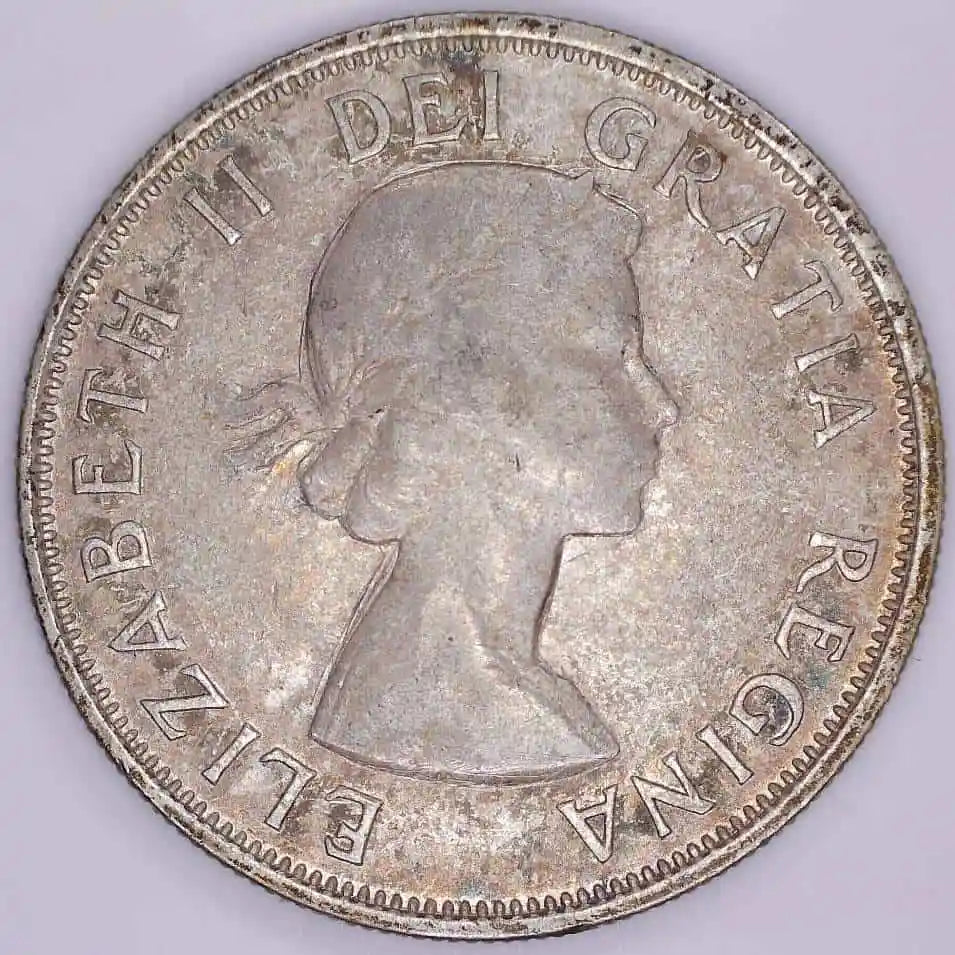
Canada - 50 cents 1960 - Circulated
Canada - 50 cents 1960 - Circulated
Couldn't load pickup availability
Canada - 50 cents 1960 - Circulated
Characteristics
- Composition: 80% silver, 20% copper
- Weight: 11.66 grams
- Diameter: 29.72 mm, thickness 2 mm
- Engraving:Obverse: T. H. Paget, Reverse: G. E. Kruger- Gray
- Illustrator: Obverse: T. H. Paget, Reverse: G. E. Kruger- Gray
- Tranche: Channelled
- Non-magnetic
- Strike angle: ↑↑
Number of circulation coins produced
- 50 cents 1960:
Elizabeth II (1953‑1964)
The first effigy of Her Majesty Queen Elizabeth II was struck in 1953, when she was 27 years old. The effigy depicted here adorned the coins until 1964, surrounded by the Latin inscription ELIZABETH II DEI GRATIA REGINA, which means "Elizabeth II, Queen by the Grace of God".
Blazon of the Arms of Canada
This version reproduces the coats of arms described in the Royal Proclamation of 1763. The four founding nations on the coat of arms of Canada are represented by the three leopards of England, the lion of Scotland, the fleur-de-lis of France, and the royal harp of Tara. The lion of England unfurls the flag of the United Kingdom and the unicorn of Scotland that unfurls the flag of the French kingdom. The floral emblems commemorate royal symbols such as the English rose, the Scottish thistle, the French rose, and the Irish clover. The royal crown triumphs over the coats of arms described above and identifies it as that of the Sovereign of Canada.
Reverse
A simplified version of the coat of arms of Canada, with some elements and floral emblems being excluded. There is also no "color" (in the heraldic sense). The escutcheon contains the arms of England (three lions), Scotland (a roaring lion), Royalist France (three fleurs-de-lys) and Ireland (a harp). An Imperial crown crowns the whole. The Scottish unicorn holds a Royalist French flag, while the English lion holds an English flag.
Share